
 English
 Русский

10:23AM 11/26/2026
preeti mmr
preeti mmr

preeti mmr > 09:43AM 09/23/2026
B2C Mobility Sharing Market Forecast: Global Market Growth, Trends, and Outlook to 2032
Market Overview
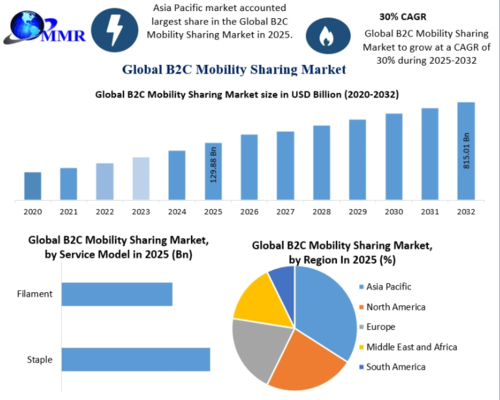
The B2C Mobility Sharing Market is undergoing significant transformation as consumers increasingly shift toward flexible, technology-enabled, and cost-efficient transportation solutions. The market was valued at approximately USD 129.88 Billion in 2025 and is projected to expand at a CAGR of 30% from 2026 to 2032, reaching nearly USD 815.01 Billion by 2032.
Download PDF Brochure: https://www.maximizemarketresearch.com/request-sample/81705/
B2C mobility sharing refers to transportation services delivered directly from mobility providers to individual consumers. These services include vehicle sharing, ride-hailing, ride-sourcing, and related shared transportation models, where providers generally own, lease, or manage fleets that consumers access through usage-based fees, subscriptions, or other payment structures. The model allows consumers to access transportation without bearing the complete costs associated with vehicle ownership, including acquisition, maintenance, insurance, fuel, parking, and depreciation.
The expansion of connected vehicles, smartphone penetration, digital payment infrastructure, and app-based transportation platforms is reshaping how consumers access mobility services. Consumers can increasingly locate vehicles, book rides, make payments, and monitor journeys through integrated mobile applications.
Urbanization and increasing traffic congestion are also contributing to the adoption of shared transportation. In densely populated cities, mobility sharing can provide an alternative to private vehicle ownership while supporting more efficient utilization of transportation assets. Rising fuel prices and the increasing cost of purchasing and maintaining private automobiles are further encouraging consumers to explore shared mobility options.
The market is also benefiting from growing interest in transportation solutions that can contribute to reduced congestion and lower greenhouse gas emissions. The integration of electric vehicles, connected technologies, intelligent fleet management, and increasingly automated driving technologies is expected to create additional opportunities across the B2C mobility sharing ecosystem.
Market Drivers and Trends
Increasing Cost of Private Vehicle Ownership
One of the primary factors supporting B2C mobility sharing adoption is the increasing overall cost of owning a personal vehicle. Beyond the initial purchase price, consumers must account for insurance, fuel, repairs, maintenance, parking, registration, and depreciation. Shared mobility allows users to pay for transportation according to their actual usage, creating an alternative for consumers who do not require a privately owned vehicle for every journey.
Download PDF Brochure: https://www.maximizemarketresearch.com/request-sample/81705/
Rapid Smartphone and Digital Platform Adoption
Smartphones have become an essential component of modern mobility services. B2C mobility platforms use mobile applications to enable vehicle discovery, ride booking, digital payments, route tracking, customer support, and service management. The continued expansion of mobile internet connectivity and digital payment systems is therefore strengthening the accessibility of mobility-sharing services.
Expansion of Connected Vehicles
Connected vehicle technology is enabling mobility providers to manage fleets more efficiently. Real-time vehicle monitoring, GPS-based tracking, predictive maintenance, remote diagnostics, and data-driven fleet allocation can improve operational efficiency and customer experience. As connected vehicles become more widespread, mobility providers are expected to integrate increasingly sophisticated digital capabilities into their services.
Urbanization and Traffic Congestion
Growing urban populations are placing pressure on existing transportation infrastructure. Traffic congestion, limited parking availability, and longer commuting times are encouraging consumers and governments to consider alternative transportation models. B2C mobility sharing can provide flexible transportation options while improving vehicle utilization.
Electrification and Sustainable Mobility
The transition toward electric mobility represents another important development for the market. Electric vehicles can be integrated into shared fleets, particularly in cities seeking to reduce emissions from transportation. Government initiatives supporting electric vehicles, charging infrastructure, and sustainable transportation can further support the deployment of electric shared-mobility fleets.
Development of Autonomous and Semi-Autonomous Vehicles
Advancements in automated driving technologies could create new opportunities for mobility-sharing providers. Semi-automated and fully autonomous vehicles may eventually enable new service models, improve fleet utilization, and change the economics of shared transportation. Although widespread autonomous mobility remains subject to technological, regulatory, infrastructure, and consumer-acceptance considerations, continued development is expected to influence the industry's long-term direction.
Primary Market Constraints
Despite substantial growth opportunities, the B2C Mobility Sharing Market faces several challenges. Consumer attitudes toward sharing transportation with strangers can affect adoption, particularly where users prioritize privacy, personal security, or individual travel experiences.
Data privacy and cybersecurity are additional concerns. B2C mobility platforms collect and process information related to accounts, payment transactions, locations, travel patterns, and vehicle usage. Maintaining secure digital infrastructure and protecting consumer information is therefore important for service providers.
Competition from traditional transportation providers can also constrain market development. Local taxi operators, conventional car rental companies, public transportation providers, and other established mobility businesses may compete directly or indirectly with shared mobility platforms.
The availability of B2C mobility solutions can also vary substantially between urban and non-urban areas. High population density generally provides favorable conditions for shared mobility because providers can achieve higher vehicle utilization. In less densely populated areas, limited demand, greater travel distances, and infrastructure constraints can make fleet deployment more challenging.
Operational costs, regulatory requirements, fleet management expenses, vehicle maintenance, insurance, and charging infrastructure for electric fleets may also influence profitability. Mobility providers must balance competitive pricing with the costs associated with maintaining reliable and accessible services.
Key Market Segments
The B2C Mobility Sharing Market can be evaluated across service model, vehicle type, and geographic region, allowing industry participants to identify differences in consumer demand and market development.
By Service Model
Service-model segmentation includes mobility services that provide consumers with direct access to transportation through provider-managed fleets. Ride-hailing and ride-sourcing represent important service categories, allowing consumers to request transportation through digital platforms.
Vehicle-sharing services represent another major segment, enabling customers to access vehicles for specific periods or distances. Depending on the service model, customers may pay based on time, distance, subscription arrangements, or a combination of pricing mechanisms.
The development of flexible pricing, digital subscriptions, and integrated mobility platforms is expected to support service-model diversification during the forecast period.
By Vehicle Type
The vehicle segment includes different transportation options designed to address consumer requirements related to convenience, comfort, affordability, and travel distance. Cars and other road vehicles remain important to B2C mobility sharing because they provide flexible point-to-point transportation and can be used for both short and longer urban journeys.
Increasing consumer interest in comfortable and safe transportation, together with the development of connected and automated vehicles, is expected to influence vehicle selection across shared fleets. Electric vehicles are also expected to gain greater representation as mobility providers pursue lower-emission fleet strategies.
Download PDF Brochure: https://www.maximizemarketresearch.com/request-sample/81705/
By Region
The global B2C Mobility Sharing Market covers North America, Europe, Asia Pacific, the Middle East and Africa, and South America.
Asia Pacific held the largest market share in 2025. The region's substantial urban population, expanding smartphone penetration, increasing digital platform adoption, and growing demand for flexible transportation services provide favorable conditions for mobility-sharing development. Countries including China, India, Japan, South Korea, and Australia represent important markets within the region.
North America is characterized by strong technology adoption, established ride-hailing platforms, and significant consumer awareness of app-based transportation. The United States and Canada remain important markets for shared mobility services.
Europe is experiencing growing interest in sustainable urban transportation, electrification, and alternatives to private vehicle ownership. The United Kingdom, Germany, France, Italy, Spain, Sweden, and other European markets contribute to regional development.
The Middle East and Africa and South America are also expected to offer opportunities as digital mobility platforms expand and urban transportation requirements increase.
Major Industry Players
The B2C Mobility Sharing Market is characterized by the presence of global technology platforms, ride-hailing companies, vehicle rental organizations, and regional mobility providers. Key companies identified in the market include:
Uber Technologies Inc.
ANI Technologies Pvt. Ltd. (OLA)
Lyft Inc.
Grab
Careem
Taxify OÜ
Beijing Xiaoju Technology Co. Ltd. (DiDi Chuxing)
Cabify
Europcar
The Hertz Corporation
Avis Budget Group Inc.
Enterprise Holdings Inc.
Competition within the market is influenced by fleet availability, geographic coverage, pricing structures, application functionality, customer experience, technological capabilities, partnerships, and the ability to efficiently manage vehicle supply and demand.
As the market develops, companies are expected to focus on expanding geographic coverage, strengthening digital platforms, integrating connected vehicles, increasing electric fleet adoption, and developing flexible pricing and subscription models.
Frequently Asked Questions
1. What is the projected size of the B2C Mobility Sharing Market by 2032?
The B2C Mobility Sharing Market is projected to reach approximately USD 815.01 Billion by 2032, compared with USD 129.88 Billion in 2025.
2. What is the expected CAGR of the B2C Mobility Sharing Market?
The market is expected to grow at a CAGR of 30% during the forecast period from 2026 to 2032.
3. Which region held the largest share of the B2C Mobility Sharing Market in 2025?
According to the provided market assessment, Asia Pacific held the highest market share in 2025, supported by urbanization, smartphone penetration, digital mobility platforms, and growing transportation demand.
4. What are the major factors driving the B2C Mobility Sharing Market?
Major growth factors include the increasing cost of private vehicle ownership, rising fuel prices, smartphone penetration, connected vehicles, urban traffic congestion, growing demand for convenient transportation, increasing digital payment adoption, and government interest in sustainable mobility solutions.
5. What are the major restraints affecting the market?
Key constraints include consumer concerns about traveling with strangers, privacy and cybersecurity concerns, competition from traditional taxi and transportation providers, operational costs, regulatory requirements, and limited availability of shared mobility services in some non-urban areas.
Conclusion
The B2C Mobility Sharing Market is positioned for substantial expansion as consumers, businesses, and cities increasingly explore alternatives to conventional private vehicle ownership. With the market projected to increase from USD 129.88 Billion in 2025 to nearly USD 815.01 Billion by 2032, technology, urbanization, changing consumer transportation preferences, and the development of connected and electric vehicles are expected to remain central to market development.
Connect With Us:
MAXIMIZE MARKET RESEARCH PVT. LTD.
2nd Floor, Navale IT park Phase 3,
Pune Banglore Highway, Narhe
Pune, Maharashtra 411041, India.
+91 9607365656
sales@maximizemarketresearch.com
About Maximize Market Research:
Maximize Market Research is one of the fastest-growing market research and business consulting firms serving clients globally. Our revenue impact and focused growth-driven research initiatives make us a proud partner of majority of the Fortune 500 companies. We have a diversified portfolio and serve a variety of industries such as IT & telecom, chemical, food & beverage, aerospace & defense, healthcare and others.
