
 Русский
 English

10:23 26.11.2026
preeti mmr
preeti mmr

preeti mmr > 09:41 21.09.2026
Sand Control Tools Market Forecast: Growth, Size, Share, Trends and Industry Outlook 2025–2032
Market Overview
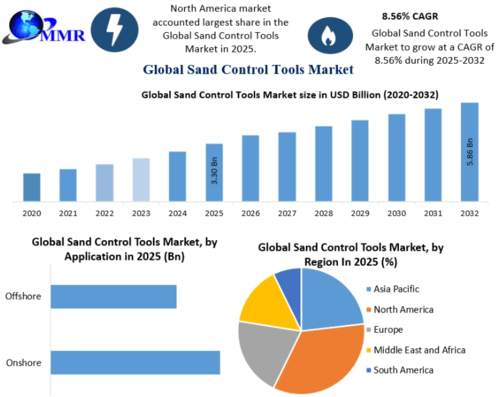
The Sand Control Tools Market is experiencing steady expansion as oil and gas operators increasingly adopt advanced technologies to manage sand production, protect well infrastructure, and improve hydrocarbon recovery. The global Sand Control Tools Market size was valued at USD 3.30 billion in 2025 and is expected to grow at a CAGR of 8.56% from 2025 to 2032, reaching approximately USD 5.86 billion by 2032.
Request Sample Link for More Details: https://www.maximizemarketresearch.com/request-sample/147991/
Sand control refers to the management and reduction of sand formation during petroleum production. Uncontrolled sand production can cause erosion, abrasion, equipment failure, pipeline damage, production interruptions, and higher maintenance costs. Sand control tools are therefore an important part of well completion and production operations, particularly in formations containing unconsolidated or weakly consolidated sandstone.
Sand control systems are broadly categorized into passive and active approaches. Passive sand control is generally a non-intrusive strategy, while active sand control involves more intervention and the use of multiple completion tools. Common technologies include gravel pack tools, frac pack tools, sand screens, and inflow control devices (ICDs).
Inflow control devices have gained increasing attention because they can help balance inflow across a well while supporting sand management and reservoir optimization. Combining ICD technology with sand screens represents an important development in completion design, particularly for complex wells where operators seek to maintain productivity while reducing sand-related risks.
Market Drivers and Trends
Growing Oil and Gas Production and Well Optimization
One of the primary factors supporting the growth of the Sand Control Tools Market is the continued requirement to maximize production from existing and newly developed oil and gas assets. Operators are increasingly investing in technologies that can improve recovery rates, extend well productivity, and reduce operational interruptions.
Request Sample Link for More Details: https://www.maximizemarketresearch.com/request-sample/147991/
Mature oilfields represent an important opportunity because aging reservoirs can experience increasing production challenges, including formation instability and sand generation. Sand control systems can help operators manage these challenges while maintaining production efficiency and extending the productive life of wells.
Increasing Adoption of Advanced Completion Technologies
Technological advancement in drilling and well completion is transforming sand management practices. Conventional sand control techniques are increasingly being complemented or replaced by improved solutions designed to simplify completion operations and improve reliability.
ICDs, advanced sand screens, and integrated completion systems are gaining attention because they can provide more controlled reservoir inflow while reducing the potential impact of sand production. Manufacturers are increasingly focusing on integrating different sand control technologies into comprehensive completion solutions.
Increasing Offshore Exploration and Production
Offshore exploration represents a significant growth opportunity for sand control technology. Offshore wells frequently encounter complex geological conditions, high pressures, high temperatures, and unconsolidated formations that can increase the risk of sand production.
The movement of exploration and development projects from onshore environments toward shallow-water, deepwater, and ultra-deepwater assets is increasing the need for specialized sand management technologies. Sand entering production tubing, pipelines, and surface equipment can create significant operational problems, including clogging, erosion, and equipment degradation.
As offshore operators seek reliable production from increasingly complex reservoirs, demand for sand screens, gravel pack systems, frac pack solutions, and inflow control devices is expected to increase.
Focus on Production Efficiency and Cost Reduction
Oil and gas operators are placing greater emphasis on reducing operating costs while maintaining production. Sand-related failures can result in well intervention, equipment replacement, production downtime, and additional maintenance expenditure.
Advanced sand control tools can help mitigate these risks by managing sand production closer to the wellbore. Consequently, investments in sand management technologies are increasingly viewed as part of broader strategies for production optimization and asset reliability.
Primary Market Constraints
Despite positive growth prospects, the Sand Control Tools Market faces several constraints. One of the most important factors is the volatility of crude oil and natural gas prices. Fluctuations in commodity prices can influence drilling budgets, exploration programs, well completion activity, and capital expenditure across the oil and gas industry.
When oil and gas companies reduce exploration and development spending, demand for specialized completion and sand control equipment can also be affected. The dependence of sand control tools on upstream oil and gas activity therefore creates a direct connection between commodity-price cycles and market demand.
The COVID-19 pandemic also demonstrated the vulnerability of oil and gas-related supply chains and drilling activities to major economic and operational disruptions. Although industry conditions have evolved, uncertainty surrounding energy investment and project economics remains an important consideration.
Another constraint is the relatively high cost and complexity associated with certain conventional sand control techniques. Gravel packing, for example, can require specialized equipment and conventional rig operations, increasing completion costs in some applications.
Key Market Challenges
Sand control operations are particularly challenging in high-pressure, high-temperature, deepwater, and ultra-deepwater wells. These environments can place substantial mechanical and thermal demands on completion equipment.
Corrosion, erosion, wax formation, and hydrate formation can further complicate sand management operations. Equipment must maintain performance under demanding downhole conditions while providing consistent sand control throughout the production lifecycle.
Selecting an appropriate sand control solution is also dependent on reservoir characteristics, formation strength, particle-size distribution, well geometry, production rate, completion design, and expected pressure and temperature conditions. This increases the importance of reservoir-specific engineering and customized completion strategies.
Key Market Segments
By Tool Type
The Sand Control Tools Market is segmented into Gravel Pack Tool, Frac Pack Tool, Sand Screens, and Inflow Control Sources.
Gravel packing remains an established sand control technique, particularly in applications where formation sand needs to be retained while maintaining hydrocarbon flow. Sand screens are selected according to formation characteristics and particle-size distribution and are widely used to prevent unwanted sand from entering production systems.
Frac pack technology combines hydraulic fracturing and gravel packing principles and can support productivity in formations where conventional completion techniques may be less effective.
Meanwhile, inflow control devices are gaining importance in complex completion applications. Their ability to regulate inflow across different reservoir intervals makes them relevant to production optimization and sand management strategies.
By Application
The market is segmented into Onshore and Offshore applications.
The offshore segment is expected to represent a significant area of market demand, supported by increasing exploration and development activities in deepwater and ultra-deepwater environments. Offshore formations can contain loosely consolidated sand that may enter production equipment and cause erosion, blockage, and operational failures.
The Middle East, North Sea, Brazil, Gulf of Mexico, and Caspian Sea are important offshore oil and gas production regions, creating continued opportunities for advanced sand management solutions.
By Well Type
Based on well type, the market is divided into Cased Hole and Open Hole applications. The selection of sand control technology depends on reservoir characteristics, completion architecture, well conditions, and production requirements.
Request Sample Link for More Details: https://www.maximizemarketresearch.com/request-sample/147991/
Regional Market Insights
North America accounted for a dominant share of the Sand Control Tools Market in 2025. The region benefits from extensive oil and gas production activities, established oilfield services infrastructure, and continued investment in drilling and well completion technologies.
The Middle East & Africa region is expected to witness substantial growth during the forecast period. Saudi Arabia represents a major market because of its extensive oil and gas production base and the presence of reservoirs with formations that can present significant sanding tendencies. Continued exploration, field development, and production optimization activities are supporting demand for sand management technologies.
Africa also provides opportunities, particularly through deepwater and ultra-deepwater exploration and production projects. Nigeria, for example, has significant offshore hydrocarbon resources and continues to represent an important market for advanced completion technologies.
In Asia Pacific, countries including Malaysia, Indonesia, and Australia are expected to generate demand for sand control technologies as oil and gas development activities continue. Japan is also expected to register steady market development during the forecast period.
Europe remains an important hydrocarbon-producing region, with exploration and production activities across countries including Norway, the United Kingdom, and Russia contributing to the regional market landscape.
Major Industry Players
The competitive landscape of the Sand Control Tools Market includes global oilfield service providers, completion technology companies, and specialized sand management solution manufacturers. Key companies operating in the market include:
Schlumberger
Weatherford
Halliburton
National Oilwell Varco
Baker Hughes
Dialog
Interwell
Mitchell
Packers Plus
Oil States International
Superior Energy
Tendeka
Variprem
Welltec
Hebei Shengkai
Sazoil
Super Energy Service
Anton Oilfield Services
These companies focus on technology development, product innovation, strategic partnerships, geographic expansion, and integrated well completion solutions to address the changing requirements of oil and gas operators.
Frequently Asked Questions
1. What was the size of the Sand Control Tools Market in 2025?
The Sand Control Tools Market was valued at approximately USD 3.30 billion in 2025.
2. What is the expected size of the Sand Control Tools Market by 2032?
The market is expected to reach approximately USD 5.86 billion by 2032.
3. What is the expected CAGR of the Sand Control Tools Market?
The Sand Control Tools Market is expected to grow at a CAGR of 8.56% from 2025 to 2032.
4. Which segments are covered in the Sand Control Tools Market report?
The report covers Tool Type, Application, and Well Type. Tool types include Gravel Pack Tool, Frac Pack Tool, Sand Screens, and Inflow Control Sources. Applications include Onshore and Offshore, while well types include Cased Hole and Open Hole.
5. Which region is expected to hold the highest share of the Sand Control Tools Market?
North America is identified as the leading regional market based on the provided market assessment.
Conclusion
The global Sand Control Tools Market is positioned for continued growth as oil and gas producers focus on production optimization, well integrity, operational efficiency, and improved recovery from increasingly complex reservoirs. From USD 3.30 billion in 2025, the market is projected to reach USD 5.86 billion by 2032, expanding at a CAGR of 8.56%.
Connect With Us:
MAXIMIZE MARKET RESEARCH PVT. LTD.
2nd Floor, Navale IT park Phase 3,
Pune Banglore Highway, Narhe
Pune, Maharashtra 411041, India.
+91 9607365656
sales@maximizemarketresearch.com
About Maximize Market Research:
Maximize Market Research is one of the fastest-growing market research and business consulting firms serving clients globally. Our revenue impact and focused growth-driven research initiatives make us a proud partner of majority of the Fortune 500 companies. We have a diversified portfolio and serve a variety of industries such as IT & telecom, chemical, food & beverage, aerospace & defense, healthcare and others.
